
How Is Your Car’s Value Determined After an Accident in 2026?

Experiencing a car accident is stressful enough without the added confusion of navigating the resulting financial aftermath. When dealing with car value insurance claims Alberta, understanding how adjusters assess your damaged vehicle’s worth can significantly affect your final settlement.
A crash shakes you up. A few days later, your insurer sends a number for your car, and it feels too low. That number matters more than most people expect. The car value for insurance claims forms the base of your settlement, so it pays to know where it comes from.
Every claim is different. Your policy, the details of the accident, and the insurer’s own assessment all shape the result. This guide explains how it usually works in Alberta, in plain words.
The Short Answer
Insurers usually look at what your car was worth right before the accident, not what you paid for it. They check the make, model, year, trim, mileage, condition, and add-ons. Next to that, they compare similar vehicles for sale nearby. Your policy wording and the facts of your claim shape the final number.
Key Takeaways
- Insurers focus on your car’s value just before the crash, not the price on your original bill of sale.
- Mileage, condition, trim, and similar cars for sale nearby all push the number up or down.
- Your policy terms, deductible, and coverage limits change what lands in your bank account.
- A low offer is not the final word. You can ask for the report and check every detail.
- Dated records, photos, and local listings make any car value for insurance claims discussion stronger.
How Do Insurance Companies Determine Car Value?
Insurers estimate what your car would have sold for in your area the moment before the accident. Here is how insurance companies determine car value, in simple terms. They usually look at:
- Make, model, trim and year. A base model and a fully loaded one of the same year are not worth the same.
- Installed options. Leather seats, a sunroof or a tow package can count.
- Mileage and condition. Low kilometres and a clean car usually mean a higher value.
- History. Past damage, service records and documented upgrades all play a part.
- Similar cars for sale. Insurers study listings and market data for matching vehicles.
- Local conditions. Prices in Edmonton can differ from prices in another part of the country.
An appraiser or adjuster may inspect the car, review photos, or lean on valuation tools. Methods vary from one insurer to the next. That is why a vehicle valuation for insurance claims can differ between companies, even for the same car.
One point trips people up. Your car’s value before the accident is a separate figure from the cost to fix it. What the wreck could sell for today does not decide your settlement either. The insurer starts with the pre-crash picture.
What Is Actual Cash Value in Alberta Auto Insurance?
When evaluating car value insurance claims Alberta, actual cash value serves as the primary benchmark for total-loss payouts.Actual cash value is what your car was worth just before the loss, after wear and age are taken into account. Think of it as the fair market price of your car in its real condition on that day, rather than the price of a brand-new one.
Many drivers search for actual cash value car insurance Alberta because the number often looks smaller than they expected. Cars lose value every year. Kilometres pile up and parts wear down. A car you bought three years ago for $30,000 is rarely worth $30,000 today.
Actual cash value is not the same as:
- Replacement cost. The price of buying a new car.
- Agreed value. A figure set in advance, when your policy offers it.
- Your loan balance. What you still owe the lender.
Your policy wording, your coverage and the facts of your claim decide which one applies to you. Read your policy, or ask your broker to walk you through it.
What Affects Your Car Insurance Payout After an Accident in Alberta?
Multiple factors determine the final settlement amount in car value insurance claims Alberta, starting with the vehicle’s pre-accident appraisal.
Several pieces come together in a car insurance payout after an accident in Alberta:
- The assessed value of your car before the crash
- The repair estimate
- Whether the car is repairable or a total loss
- Your coverage, limits, deductible and any exclusions
- A loan or lease on the car
- Who was at fault, and by how much
A made-up example. Say the insurer values your car at $14,000 before the crash, and your deductible is $1,000. In a simple total-loss claim, the payment before other adjustments could land near $13,000. Real claims depend on your policy and the facts. Use the example only to see how value and deductible work together.
Alberta fact check. Since January 1, 2022, Alberta drivers deal with their own insurer for vehicle damage when another driver is at fault. CBC explains how this system works. Fault is worked out under rules covering more than 40 accident scenarios, according to Collision Repair Magazine’s report on the change. If you share some of the blame, your payment can shrink.
Two court decisions show how much policy wording matters. An Alberta Court of Appeal case summarized by Harper Grey upheld an insurer subtracting the deductible from a total-loss payment and keeping the wrecked car. In another case, a 2018 Alberta Provincial Court decision, the judge ruled that a drop in resale value after a repair was not covered under that standard policy. Your own policy may read differently, so check it.
What Happens If Your Car Is Declared a Total Loss?
A total loss means the insurer decides repairing your car does not make financial sense. The repair bill gets weighed against what the car was worth before the crash. Alberta has no single repair-cost line that applies to every claim, and insurers use their own rules.
Your insurer tells you its decision, usually by phone or in writing, and shares how it reached the value. Timing varies. Inspections, repair estimates, paperwork and the claim itself all affect how long you wait. No standard number of days exists.
Your payout can come in lower than what you paid. Age, kilometres and wear all come off the price. A loan or lease changes where the money goes. The lender may be paid first. If you owe more than the settlement, the extra can stay your responsibility unless gap coverage or other protection applies.
Before you agree to a settlement, ask:
- How did you arrive at this value?
- Does the report match my car’s real condition and kilometres?
- Which similar cars did you compare?
- What comes off for the deductible?
- Who gets paid first if I have a loan?
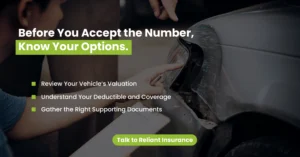
What to Do If You Think Your Car’s Valuation Is Too Low
Gathering independent evidence is the most effective way to challenge low assessments during car value insurance claims Alberta.
A low number is worth a second look. Nobody can promise a higher payment. A calm, organized review still gives you the best chance of a fair one.
- Ask for the valuation explained in writing.
- Check the make, model, trim, year, kilometres and options.
- Confirm the report matches your car’s condition before the crash.
- Collect listings for truly similar cars in your local market.
- Gather maintenance records, your bill of sale, photos and receipts for upgrades.
- Ask your adjuster how your evidence was weighed against the report.
- Read your policy and ask about the insurer’s internal review process.
- If the gap stays, look at Alberta’s complaint and dispute options.
A word on listings. Asking prices are not selling prices. Compare cars with matching kilometres, trim and condition, in your area.
Documents that support your car value for insurance claims
- Bill of sale or purchase invoice
- Service and maintenance records
- Photos from before the accident
- Details of trim, factory options and equipment
- Receipts for upgrades or recent work
- Listings for similar cars
- The insurer’s valuation report and claim emails
Dated, organized papers keep the conversation on facts. An adjuster can follow a clean folder far more easily than a pile of loose receipts.
Questions to ask about Alberta auto insurance claims
- What method did you use to value my car?
- What kilometres and condition did you record?
- Which similar cars did you compare?
- How did you handle differences in trim, options and condition?
- Which deductible and policy terms apply?
- Can I send more evidence for review?
- What happens if I still disagree?
If talks stall: The Government of Alberta says you can start by contacting your adjuster, then your insurer’s complaint liaison officer or ombudsperson. All insurers in Alberta must have an ombudsperson. The Alberta insurance consumer complaints page lists next steps. It also says the Superintendent of Insurance can help pick an umpire when representatives cannot agree on one.
Don’t Take the First Number Without Asking Why
A quick review can protect your claim:
- Ask for the valuation report in writing.
- Match every detail on the report to your real car.
- Save dated photos and service records now.
- Compare local listings, not national averages.
- Know your deductible before you sign.
Frequently Asked Questions
Is an insurance payout based on what I originally paid for my car?
Usually not. Insurers look at what your car was worth just before the accident, after age, kilometres and wear. That figure is often below your purchase price. Your policy wording and coverage still apply, so some policies may work differently.
How do insurance companies determine car value after an accident?
They study your car’s make, model, year, trim, kilometres, condition and options. They compare similar cars for sale in your area and may inspect your car or review photos. Methods differ by insurer, and your policy decides how the final figure is used.
Can I dispute my car’s insurance valuation in Alberta?
Yes, you can ask questions and push back. Request the report, point out errors, and send local listings and records. Ask about your insurer’s review process. Alberta also lists complaint options on its government website. Nobody can guarantee a result.
Does mileage affect my car’s insurance claim value?
Yes. Higher kilometres usually lower the value, since the car has more wear. Mileage works together with age, trim, condition and local market prices. Two cars with the same kilometres can still be valued differently.
What happens if my car loan is higher than the insurance payout?
You may still owe the difference. The lender is often paid first from the settlement. Gap coverage or similar protection can help, and it depends on your loan contract and policy. Check both before you assume the debt disappears.
Final Thoughts
Staying informed about car value insurance claims Alberta helps you protect your financial interests when negotiating with adjusters. Knowing how car value for insurance claims works puts you in a stronger spot. You can read the report with clear eyes, spot mistakes, and ask your adjuster better questions. Keep your records tidy and your questions specific. A fair settlement often starts there.
Want to talk through your coverage before something goes wrong? Visit Reliant Insurance or reach out to the team. Reliant does not make claim decisions for insurers or promise a payout. The team can help you understand your options.
This article gives general information. It is not personal insurance or legal advice. Your policy and your situation decide what applies to you.
Comments are closed.